
January 16th, 2026
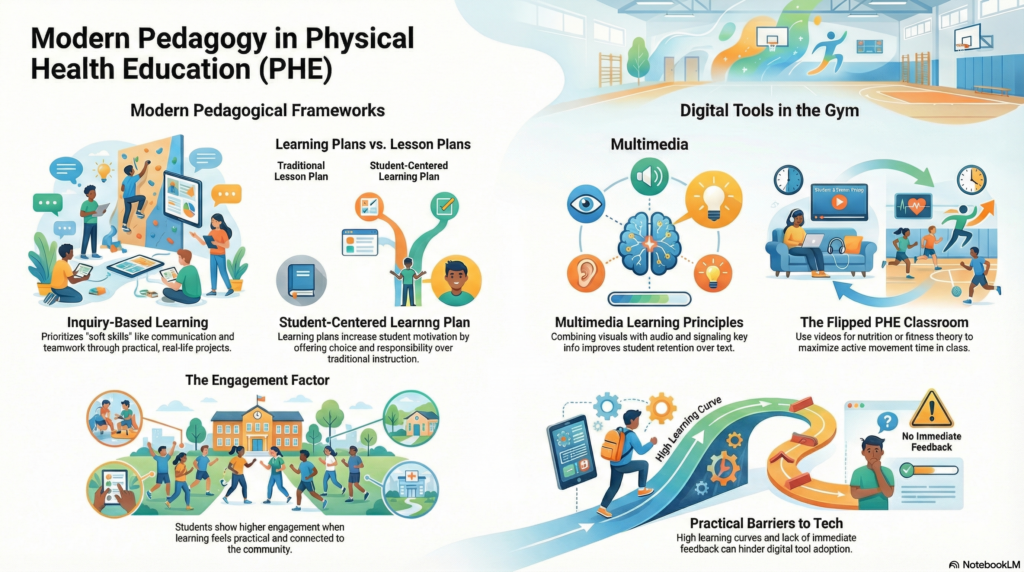
This week we focused on inquiry-based learning, learning plans versus lesson plans, privacy and safety, and expectations for the inquiry and group projects. We had to watch the video “Most likely to Succeed” and discuss it in breakout rooms. The video was about a school that focuses on community and project-based learning. Students were taught soft skills, like communication, teamwork, problem solving, and adaptability. The students seemed more motivated and engaged because the learning felt practical and connected to real life. While I believe this is a good idea and approach, it doesn’t translate well with current school systems. As one of our classmates mentioned there seemed to be a lack of literacy or they may have just not shown too much of it, but what about physical literacy? The whole video seemed to only focus on science-based learning.
We also talked about learning plans versus lesson plans. Learning plans are used more for inquiry projects and involve choosing a topic and planning how learning will occur. This gives students more responsibility and choice, making it more motivating. Lesson plans are more teacher lead, which may not work for everyone needs, and could be less motivating for students.
Another portion of the class discussed privacy and safety. We discussed consent and the importance of having a back up plan when consent isn’t given. We briefly talked about open educational resources, creative commons and copyright.
January 23rd, 2026
This week we focused on multimedia and how it can be used in teaching. We discussed image principles, sketch noting, and strategies for creating educational videos to help students learn. We were shown different types of videos, including computer simulations, screencasts, virtual reality, 360-degree videos, and animated GIFs. This connected to the pre-class video we watched and how to use videos as learning tools, as well as things to avoid when creating them. We also learned about the flipped classroom strategy, and we went over video editing, screen capture, interactive videos, podcasts, digital storytelling, and we briefly discussed personal learning network. During class, we also created an interactive activity using H5P.
Prompts:
Reflections on H5P Tools
I don’t think H5P would be very helpful for me as a future PHE teacher. Most physical education learning happens through movement and participation, which is hard to measure using online interactive tools. H5P could be useful in other subjects, but it also has a big learning curve. Both teachers and students would need time to learn how to use it properly, which may not always be practical.
Using Video or Audio Editing for Assignments
Video or audio editing is not very applicable for most PHE classes. However, it could work if PHE was combined with another subject, such as film. For example, students could create videos showing different physical movements and compare them to professional athletes. This could help students analyze technique and performance. Even though this could be engaging, it would be hard to organize and manage, especially with large classes and limited time.
Multimedia Learning Theory
Multimedia Learning Theory can help make instructional videos more effective by combining visuals and words instead of using only text. I think the multimedia principle is important because it helps students understand information better when they can see and hear it at the same time. The signaling principle is also useful because it helps point out important information and keeps students focused on key ideas.
Flipped Classroom in PHE
A flipped classroom could work in PHE for certain health topics that there may not be enough time to teach in class. Videos could explain things like nutrition, fitness concepts, or injury prevention more clearly than a short lesson during class. However, since the videos would be watched at home, students would not be able to ask questions right away. This could make it harder for some students to fully understand the material, especially if they struggle with independent learning.
Video overview of the Harmonica using H5P
January 30th, 2026
This week, we focused on understanding Gen AI and how it is being used for education. We went over what Gen AI is, how it works, and how to evaluate whether its outputs are reliable and high quality. We also talked about how AI tools are becoming more common and how teachers and students are starting to use them in different ways.
We discussed examples such as Pat’s Macbeth assignment and the case of a BC lawyer using ChatGPT in court. These examples showed how AI can be useful but also risky if it is relied on too much. One key point is that Gen AI is not actually intelligent, it can make mistakes, create fake quotes and produce incorrect citations. It was compared to an over-eager research assistant who sounds confident even when it is wrong. Because of this, users need to fact-check and think critically about what AI produces.
We also talked about how AI is a double-edged sword. It can be very effective for people who already have strong knowledge in a subject because they can recognize errors and improve the output. However, it is more dangerous for beginners since they may not have questioned what AI gives them. This can lead to misinformation an over reliance. We also discussed how Gen. AI can contribute to deskilling by reducing opportunities for people to practice critical thinking problem solving and creative work. In some cases, it may also replace certain jobs.
- Two ways you have used GenAI or have seen it being used in education or K-12 (good or bad)
- One way you are planning -or- wish to use GenAI as a teacher
Based on these two questions, in my experience, I have used AI to help organize notes and summarize text, especially because I struggle with dyslexia. In this way, it helps make schoolwork more manageable. However, I have seen students use AI like a search engine, asking basic questions they should already know or simple things they are just curious about. Since AI is not always accurate, this can be a problem if students trust it too much. In the future, I plan to use AI to help adapt lesson plans to meet my students’ needs, or as a time-saving tool when I’m under pressure. For example, I could use it to help create discussion questions, generate topic ideas or design simple infographics. I would not rely on it to do my main thinking, but rather as a support.
Another topic was the environmental impact of Gen AI. We learned how much energy is used for different types of prompts. Image prompts use but 20% less energy than text prompts, while video prompts use as much energy as around 700 text prompts. This shows that AI use also has environmental consequences that everyone considers.
February 6th, 2026
Today, I went to Pacific School of Innovation and Inquiry with half the class. It started with a 30-minute introduction about the school, what they do there, and all the details about it in comparison to public schools. I found the school to be very interesting, and it would be interesting to go there for a day as an observer to watch how students and teachers operate.
Sadly, the school doesn’t touch too much in the realm of PHE, but that’s completely understandable given its location and structure. However, in other subject areas, it offers a wide range of opportunities to chase personal curiosity and interests. This creates a learning environment that feels flexible and student-centered.
Some of my classmates asked questions such as, “Is assessment compatible with the proficiency scale?” and “what the day of a teacher look like?” These questions, along with others, helped give us a better idea of school operations.
After the introduction and questions, we all went on a brief tour around the school. It was very interesting to see the layout and how it’s managed to grow in such a small building downtown.
