Accessibility
Understanding accessibility by watching the videos of James, Emily, Rikki, and Annie. They teach us how accessibility is different for everyone, whether they are blind, deaf, in a wheelchair or autistic and others. Having the world around us be accessible for everyone and all their needs, and for this course more specifically, technology. Having tech be accessible with different features to help everyone is very important.
- One-fifth of all Canadians are diagnosed with a disability
- 1.6 million Canadians can’t afford aids to help them
Many people around the world have to access digital documents and content differently from others. Having to use screen readers, braille displays, zoom functions, high contrast functions, captions, transcripts, speech detection, and keyboard-only interaction. These digital accessibility functions allow everyone to operate in the modern world; without them, many would struggle. Many countries around the world are implementing Web Content Accessibility Guidelines (WCAG) to help make websites and apps easy for everyone.
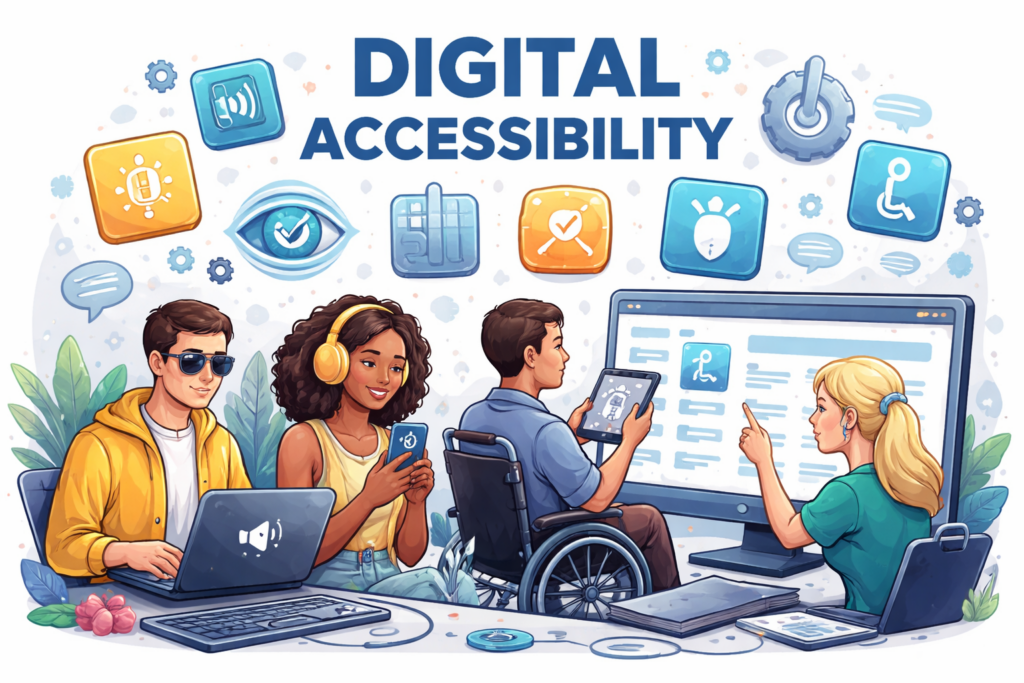
OpenAI. (2026). ChatGPT (5.2) [Large language model]. https://chat.openai.com/chat.
Are there any digital accessibility practices that you often see being missed? Are there any that you know YOU often miss?
Some practices that I often see being missed is speech to text. I believe that this is a powerful use of technology, especially for those who may struggle with typing, writing, and maybe even reading. It allows individuals to say what’s on their minds without worrying about how to spell something, or if that cant access their keyboard. Unfortunately, I don’t use this enough; it would make my life a bit easier when it comes to taking notes after class or when I am trying to organize my thoughts.
Why do you think many digital accessibility practices aren’t more well-known or commonly used?
I believe that many digital accessibility practices aren’t as well-known or commonly used because roughly 22% of Canadians have a disability, and not every disability needs the use of digital accessibility, making it less than 22%, which makes it not very well-known. That being said, it’s amazing that digital content, websites, and apps have the option for accessibility. I also believe that it’s not commonly used because many people may not know that the technology exists or how to use it.
